Part component;
1 BC547 transistor
1 10k Ohm potentiometer
2 10k Ohm resistors
2 100nF condensators
1 220k Ohm resistor
1 15k Ohm resistor
Try and Try Forever to get new of knowledge

The circuit in this figure is protecting the circuit and the system with power supplies that may exceed safe limits. One example is small consumer products that use external ac adapters; it's easy to mistakenly plug in the wrong adapter. Another example is a portable system that uses a rechargeable battery pack. If the battery pack is absent or fails to open during recharging, a high-compliance charger can deliver excessive voltages to the system.
The circuit works using LM4041 adjustable shunt-voltage regulator as a voltage detector. When it operates as a reference, the LM4041 develops a voltage across its positive and negative terminals. This signal forces the voltage across R1 to equal 1.24V. In this circuit, however, R3 prevents this servo action. With R3 in the circuit, VG is near ground when the voltage across R1 is less than 1.24V, and VG is approximately 1V below the positive rail when the voltage across R1 is greater than 1.24V. You can, therefore, set a threshold voltage by selecting appropriate values of R1 and R2. When the supply voltage exceeds the threshold, VG goes high, thereby turning off Q1 and removing power from the load. Select R1 and R2 according to:
It where VSHUTOFF is the supply voltage that causes shutoff. With the values shown, the circuit removes power from the load when the supply voltage reaches approximately 6V. R4 provides hysteresis to prevent chattering when the supply voltage is near the shutoff value. IC1 can accommodate shutoff voltages as high as 10V; clamping IC1's supply voltage with another inexpensive shunt reference or zener diode (across the positive and negative terminals) allows higher maximum shutoff voltages. Maximum supply voltage with the components is approximately 50V.
Parts:
R1,R2,R8 1K 1/4W Resistors
R3,R4 220K 1/4W Resistors
R5 100R 1/4W Resistor (See Notes)
R6 10K 1/2W Trimmer Cermet
R7,R10 1M 1/4W Resistors
R9 22K 1/2W Resistor
R11 to R17 1K 1/4W Resistors
C1,C3 100µF 25V Electrolytic Capacitors
C2,C4 1µF 63V Electrolytic Capacitors
D1 5mm. Red LED
D3,D4 1N4002 100V 1A Diodes
D2,D5,D6,D7 LEDs (Any color and size)
Q1 BC327 45V 800mA PNP Transistor
IC1 TL061 Low current BIFET Op-Amp (First version)
IC1 LM358 Low Power Dual Op-amp (Second version)
IC1 LM324 Low Power Quad Op-amp (Third version)
L1 10mH miniature Inductor (See Notes)
RL1 Relay with SPDT 2A @ 220V switch
Coil Voltage 12V. Coil resistance 200-300 Ohm
J1 Two ways output socket
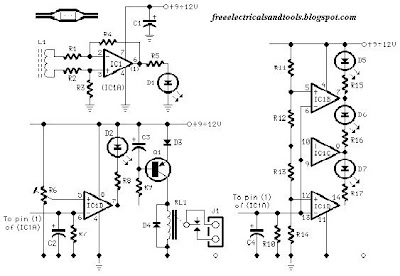
This circuit was designed on request, to remotely monitor when a couple of electric heaters have been left on. Its sensor must be placed in contact with the feeder to be able to monitor when the power cable is drawing current, thus causing the circuit to switch-on a LED. The circuit and its sensor coil can be placed very far from the actual load, provided an easy access to the power cable is available.
Any type of high-current load or group of loads can be monitored, e.g. heaters, motors, washing machines, dish-washers, electric ovens etc., provided they dissipate a power comprised at least in the 0.5 - 1KW range. This design features three versions. The basic one illuminates a LED when the load is on. The second version activates a Relay when a pre-set current value flows into the power cable. The third version switches-on D7 when the load power is about 1KW, D6 when the load power is about 2KW and D5 when the load power is about 3KW.
The basic circuit is shown top left in the drawing and must be used in all three versions. IC1 acts as a differential amplifier having a gain of 220. The small AC voltage picked-up by L1 is therefore amplified to a value capable of driving the LED D1.
The second version is drawn bottom left, must be connected to the basic circuit and uses a dual op-amp: therefore IC1 will be labeled IC1A and its pin layout varies slightly. IC1B acts as a voltage comparator and its threshold voltage can be precisely set by means of trimmer R6. Q1 is the Relay driver and D2 illuminates when the Relay is on. You can use the Relay contacts to drive an alarm or a lamp when the AC load exceeds a pre-set value, e.g. 2KW.
The third version is shown to the right of the drawing, must be connected to the basic circuit and uses a quad op-amp, therefore IC1 will be labeled IC1A and its pin layout varies slightly. IC1B, C and D are wired as comparators. They switch on and off the LEDs, referring to voltages at their non-inverting inputs set by the voltage divider resistor chain R11-R14.
The two circuits below illustrate generating low frequency sine waves by shifting the phase of the signal through an RC network so that oscillation occurs where the total phase shift is 360 degrees. The transistor circuit on the right produces a reasonable sine wave at the collector of the 3904 which is buffered by the JFET to yield a low impedance output. The circuit gain is critical for low distortion and you may need to adjust the 500 ohm resistor to achieve a stable waveform with minimum distortion. The transistor circuit is not recommended for practical applications due to the critical adjustments needed.
The op-amp based phase shift oscillator is much more stable than the single transistor version since the gain can be set higher than needed to sustain oscillation and the output is taken from the RC network which filters out most of the harmonic distortion. The sine wave output from the RC network is buffered and the amplitude restored by the second (top) op-amp which has gain of around 28dB.
Frequency is around 600 Hz for RC values shown (7.5K and 0.1uF) and can be reduced by proportionally increasing the network resistors (7.5K). The 7.5K value at pin 2 of the op-amp controls the oscillator circuit gain and is selected so that the output at pin 1 is slightly clipped at the positive and negative peaks. The sine wave output at pin 7 is about 5 volts p-p using a 12 volt supply and appears very clean on a scope since the RC network filters out most all distortion occurring at pin 1.
Current models of spectrum analyzers routinely offer frequency responses that begin as low as 10 Hz. When you combine them with 1-Hz or narrower band FFT software, expanded low-frequency performance makes the modern spectrum analyzer an invaluable tool for designing and debugging high-performance analog circuits. Unfortunately, a spectrum analyzer that’s primarily for RF typically presents an input impedance of 50, a heavy load when you apply it to most high impedance analog circuits. You can improvise a some what higher impedance probe by adding a 953 resistor in series with the 50 input, but this approach provides only 1K input impedance and reduces the measured signal by 26 dB. In addition, most RF-spectrum analyzers lack ac coupling, and, thus, any dc-input component directly reaches either the internal terminating resistor or the front-end mixer.
To maintain a 10-Hz, low-frequency response, you must connect a coupling capacitor with a value of at least 2F in series with the 953 input probes. Although oscilloscopes’ input circuits can withstand accidental probe contacts and capacitive-transient overloads, using a low impedance, ac-coupled probe with a spectrum analyzer can lead to destruction of the analyzer’s expensive and possibly hard-to-replace front-end mixer. Although high-impedance probes are commercially available, they’re expensive to purchase and repair. This Design idea offers an alternative: an inexpensive and well-protected unity-gain probe that presents the same input impedance as a basic bench oscilloscope and can drive the spectrum analyzer is 50 input impedances. The probe has a gain of 0 - 0.2 dB at 100 kHz. Input impedance is 1 M, 15 pF, and maximum input is 0.8V p-p. Load impedance is 50, and frequency response is 10 Hz to 200 MHz at 3 dB. Pass band ripple is less than 1 dB p-p.
Input noise at 1 MHz is less than 10 nV/Hz. Distortion for 0.5V p-p input at 10 MHz is less than 75 dBc for second-order distortion and less than 85 dBc for third order. Power requirements are 5V at 16 mA. You can assemble the circuit in the figure readily available and inexpensive components. The circuit’s input presents the same characteristics as a bench oscilloscope 1-M resistance in parallel with 15 pF of capacitance. You can also use this active probe in place of standard 1-to-1 or 10-to-1 oscilloscope probes, thus extending the designs applicability. The back-to-back silicon diodes in the D1 clamp the input signal to plus or minus one forward-voltage drop, which limits signal excursions you apply to the spectrum analyzer’s front end, thus protecting the input mixer from damage due to overloads and ESD.
Because most users employ the probe and spectrum analyzer to measure small-amplitude signals and noise, the limited large-signal response does not affect most applications. High-performance FET input operational amplifier IC1, a Texas Instruments OPA656, provides a voltage gain of two. This configuration yields a bandwidth of approximately 200 MHz the OPA656 can drive 50 back-matched loads for a total load of 100, which results in a 6-dB gain loss for which IC1’s gain of two compensates for a net gain of unity. The OPA656 also introduces lower noise and distortion than that of most commercially available, active FET-based probes.
The probe in the figure fits into a small section of brass hobby tubing. The input connector comprises a small SMA edge-launch connector that you can easily adapt to other connectors, including the BNC and its many accessories. The probe requires 5 and 5V at approximately 18 mA each, which you can obtain from an instruments probe-power connector if available or from a linear supply designed around an ac wall transformer. For best results, use 78L05 and 79L05 voltage regulators to stabilize the supply voltages. Standard miniature 50 coaxial cable connects the probe to the measuring instrument. For the flattest frequency response and uniform gain, terminate the probes output with 50, the circuit requires no dc-output-blocking capacitor
This is a low power voltmeter circuit that can be used with alternative energy systems that run on 12 and 24 volt batteries. The voltmeter is an expanded scale type that indicates small voltage steps over the 10 to 16 volt range for 12 volt batteries and over the 22 to 32 volt range for 24 volt batteries. Power consumption can be as low as 14mw when operated from 12V and 160mw when operated from 24V.
It is possible to set the meter to read equal steps across a variety of upper and lower voltages. The meter saves power by operating in a low duty-cycle blinking mode where the LED indicators are only on and consuming power briefly during a repeating 2 second cycle. The circuit may be switched to a high power mode where the active LED stays on at all times.
Different colored LEDs may be used for the voltage level indicators, this allows the battery state to be read in the dark. With the new blue LEDs, it is possible to have a nice looking rainbow of colors using two each of red, amber, yellow, green, and blue LEDs. The circuit will also work with inexpensive and common red LEDs. If the circuit is to be used in sunlight, ultra-bright LEDs should be used, although even those may be hard to read without some kind of sun shield.
The heart of the circuit is the LM3914N dot-bar volt meter IC, U2. This chip is operated in the expanded-scale mode so that the circuit responds in the 10-16V range.
U2 outputs a steady voltage on pin 7 from the internal voltage reference. This is fed via voltage dividers VR2 and R5 to the internal reference input pins to set the range that the meter is sensitive to. The measured voltage is fed in on pin 5 via the voltage divider consisting of R4 and VR1. This divider scales the input voltage down to a range that is useful to the IC.
The U2 positive supply is connected to pin 3 which is nominally 12V. The U2 negative supply is switched on momentarily via transistor Q1, this switching action is what makes the circuit efficient since U1 (ICM7555) consumes a mere 0.34 ma while U2 consumes around 18ma with one LED on. The ICM7555 timer, U1 is wired to run in a free-running mode with a narrow pulse width square wave output.
The duty-cycle of U1 is controlled by the ratio of R1 and R2. R2 may be adjusted to a smaller value if faster blinking is desire, a potentiometer may be substituted for R2 if a rate adjustment is desired. R1 may be increased if a longer on-time is desired. Changes in R1 and R2 will affect the average current that the circuit consumes. The frequency of oscillation is determined by C1, R1, and R2. C1 may be either an electrolytic or poly capacitor, if an electrolytic part is used, be sure to connect the positive terminal to U1 pins 6 and 2 and the negative terminal to ground.
The output of the timer IC is fed through current limiting resistor R3 to transistor Q1 which controls power to U2. Capacitor C2 filters the control voltage input to U1 and capacitor C3 provides DC filtering for the whole circuit. When the lock-on switch across capacitor C1 is closed, the output of the timer remains on, thus enabling the U2 circuitry and increasing the current drain to 18ma. The reason the switch is not simply wired across the transistor is to keep the negative supply to U2 the same as when the circuit is pulsed on. This maintains the same calibration on the LEDs in both modes because the transistor's voltage drop is always part of the circuit.
Last, but not least, fuse F1 protects against the potential for fire hazard should the circuit become shorted out. The average current is calculated by adding the constant current required by U1 with the product of the current from U2 times the duty cycle, see the specifications for details. To operate the circuit in the 12V mode, wire the circuit so that jumpers J2 and J5 are shorted, parts U3, C4, R6, and R7 may be left out.
When wired for 24 Volt operations, the meter responds in the 20-32V range. R6 is connected to the 24V supply instead of R4, the greater value of R6 scales the higher input voltage to a range that is useful for U2. Voltage regulator U3 with series resistor R7 scales the 24V down to a regulated 12V to provide the proper operating voltage for the ICs. Resistor R7 assures that the input voltage to the regulator stays well below the 35V absolute maximum specification of the IC. Operation in 24V mode is less efficient than in 12V mode because of the extra power dissipated by the voltage regulator and R7. To operate the circuit in the 24V mode, wire the circuit so that jumpers J1, J3, and J4 are shorted. R4 may be left out in the 24V mode.
For many applications that require power-supply currents of a few amperes or less, three-terminal adjustable-output linear voltage regulators, such as National Semiconductors LM317, offer ease of use, low cost, and full on-chip overload protection. The addition of a few components can provide a three-terminal regulator with high-speed short-circuit current limiting for improved reliability. The current limiter protects the regulator from damage by holding the maximum output current at a constant level, IMAX, that doesn’t damage the regulator. When a fault condition occurs, the power dissipated in the pass transistor equals approximately VIN/IMAX. Designing a regulator to survive an overload requires conservatively rated and often overdesigned components unless you can reduce, or fold back, the output current when a fault occurs.
This above figure is Figure 1
The circuit in Figure incorporates fold back current limiting to protect the pass transistor by adding feedback resistor R4. Under normal conditions, transistor Q2 doesn’t conduct, and resistors R1 and R2 bias MOSFET Q1 into conduction. When an output overload occurs, Q2 conducts, reducing the on-state bias applied to Q1 and thus increasing its drain-source resistance and limiting the current flowing into regulator IC1, an LM317. Adding R4 makes Q2’s bias current dependent on the output voltage, VOUT, which decreases under overload conditions.
For the circuit in Figure 1, you can calculate the maximum fold over and short-circuit currents, IKNEE and ISC, respectively, as follows:
In a practical design, you select values for IKNEE and ISC and equal values for R3A and R3B and then use equations 1 and 2 to calculate resistors RSC and R4. For the circuit in Figure 1, the output’s maximum and short-circuit currents are fixed at 0.7 and 0.05A, respectively. With R3A and R3B set to 100, solving the equations yields values of 0.73 for RSC and 4.3 k for R4.You can demonstrate the circuit’s performance by applying a variable-load resistor that is adjustable from 0 to 200.
As Figure 2 shows, the output is simulated and measured voltage-versus-current characteristics VOUT, respectively, are in close agreement.